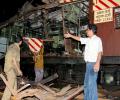
Nineteen years later, remembering how terror struck Mumbai's lifeline on July 11, 2006.
Amid Indian strikes, PCB in huddle to decide whether PSL should continue

Punjab Chief Minister Bhagwant Mann announced a Rs 5 lakh ex gratia from the Chief Minister's Relief Fund for the family of Sukhwinder Kaur. He expressed deep sorrow over Kaur's death.
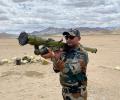
The new supplies of the Igla-S air defence missiles have been received by the Indian Army a couple of weeks ago and are being provided to the forward formations for taking care of the threat from enemy fighter aircraft, choppers and drones on the borders.
'India enjoys conventional superiority, but nuclear deterrence imposes clear boundaries.'
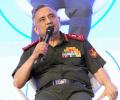
Chief of Defence Staff General Anil Chauhan on Saturday acknowledged losses of aircraft in India's recent military hostilities with Pakistan but dismissed as 'absolutely incorrect' Islamabad's claim of downing six Indian fighter jets.

The Chandigarh administration on Friday sounded a fresh air raid siren, appealing to people to remain indoors. The development came amid escalating tension between India and Pakistan.

India's Foreign Secretary Vikram Misri said on Thursday that the choice of de-escalation is with Pakistan, as India only responded to the April 22 Pahalgam terror attack, which killed 26 people. He added that Pakistan has been escalating the situation with cross-border terrorism against India for decades.

Survivors of the 2006 Mumbai train blasts express shock and disappointment after the Bombay High Court acquitted all 12 accused, citing lack of evidence. They feel justice has not been served after 19 years.
Metal debris was found scattered in three villages of Amritsar district, with some locals claiming them to be parts of missiles. Police are investigating the objects, while the Indian government claims to have foiled Pakistan military's attempts to attack 15 places in northern and western India using missiles and drones. Tensions between India and Pakistan have escalated after India launched missile strikes on terror targets in Pakistan and Pakistan-occupied Kashmir (PoK) in response to the April 22 killing of 26 people by terrorists in Kashmir's Pahalgam.

The Galwan clashes indicate to the limitations in relations if they do not address border stability, points out Srikanth Kondapalli.
The Galwan clashes indicate to the limitations in relations if they do not address border stability, points out Srikanth Kondapalli.

External Affairs Minister S Jaishankar has said the recent confrontation between India and Pakistan was not just a mere conflict between two neighbours, but it was about combating terrorism, which will eventually come back to haunt the West.

Stock market benchmark indices Sensex and Nifty tumbled over 1 per cent each on Friday as tensions soared between India and Pakistan, fuelling fears of a wider conflict.

Pakistani drones were intercepted by Indian air defence in Jaisalmer. Explosions were heard and flashes seen in the sky.
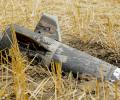
Debris resembling parts of a missile was found in a field in Hoshiarpur, Punjab, while metal parts of unidentified objects were discovered at two locations in Bathinda, sparking panic among locals. The incidents come after India successfully thwarted Pakistan's attempts to target military installations with drones and missiles across the country.

Diljit Dosanjh has finally decided to address the backlash and serious repercussions he is facing after co-starring with Pakistani actress Hania Aamir in his forthcoming film, Sardaarji 3.
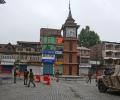
Raj Kumar Thapa, additional district development commissioner, Rajouri, and his two staff members were seriously injured when an artillery shell hit his official residence in Rajouri town, the officials said.

India's recent missile strikes on nine terrorist locations in Pakistan and Pakistan-occupied Kashmir (PoK), including Bahawalpur, mark a significant escalation in the long-standing military tensions between the two nations. This article provides a historical overview of the Indo-Pak military confrontations, tracing their roots back to the 1947 war following India's independence and the partition of the sub-continent, and highlighting key conflicts such as the 1965 war, the 1971 Bangladesh Liberation War, the 1999 Kargil War, the 2016 Uri attack, and the 2019 Pulwama attack.
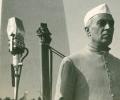
On Jawaharlal Nehru's 61st death anniversary, Utkarsh Mishra recalls how India's first prime minister cultivated a unique role for the newly independent country on the world stage.
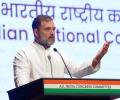
The Bharatiya Janata Party on Wednesday slammed Rahul Gandhi for his 'surrender' barb at Prime Minister Narendra Modi, saying it is not only a grave insult to the armed forces and country but also no less than treason.
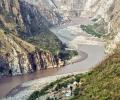
Pakistan may face a significant water shortage during the Kharif season due to reduced water supplies from India.

'If Washington has to balance Chinese power, she will have to turn to the third biggest power in the world which is India.' 'The United States and India will have to work together in order to keep Chinese ambitions in check.'
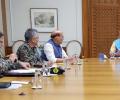
India has called Pakistan's nuclear bluff with Operation Sindoor and sent a psychological message to state-sponsored terrorists: nobody is untouchable and no place in Pakistan is safe for you, government sources said on Sunday.

AIMIM chief Asaduddin Owaisi slammed Pakistani politician Bilawal Bhutto-Zardari for his "blood would flow in rivers" remark and called former cricketer Shahid Afridi a "joker" for his comment on the Pahalgam terror attack. Owaisi also supported India's decision to suspend the Indus Waters Treaty and called for Pakistan to be placed on the FATF grey list. He also advocated for cyber attacks against Pakistan.
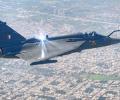
India's military expenditure in 2024 was nearly nine times that of Pakistan's, according to a study released by the Stockholm International Peace Research Institute (SIPRI). India's spending reached USD 86.1 billion, while Pakistan spent USD 10.2 billion. China's military spending continued to rise, reaching USD 314 billion, accounting for 50% of all spending in Asia and Oceania.
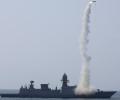
The visuals show the BrahMos anti-ship and anti-surface cruise missiles being launched from a fleet of warships, including Kolkata-class destroyers and Nilgiri and Krivak-class frigates, reaffirming the Navys operational prowess.
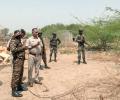
The western Rajasthan experienced a complete blackout and sirens were sounded multiple times, particularly in Barmer, to alert residents.

A villager was killed and three others were injured in shelling by Pakistan in forward areas of Jammu and Kashmir's Poonch and Rajouri districts early Friday morning, prompting Army troops to retaliate. The shelling also caused significant damage to property, with many houses and hundreds of vehicles affected. The firing and shelling were directed at areas in Rajouri, Poonch, and Jammu districts, apart from Kashmir's Kupwara and Baramulla districts, overnight.

With 17 films crossing the Rs 100 crore mark in the first six months, this year relied less on big-ticket blockbusters.

From the Sensex firms, Eternal, Mahindra & Mahindra, Maruti, Bajaj Finance, Tata Steel, Bharti Airtel, Bajaj Finserv, Asian Paints, Power Grid and State Bank of India were among the laggards. Kotak Mahindra Bank, Axis Bank, Titan, HCL Tech, Tata Motors, Infosys and Tata Consultancy Services were the gainers.
'For weeks, months and years, it would continue to be debated if India should have pushed the early advantage and decapacitated Pakistan militarily.' 'India refused to bite the provocatively proverbial bullet and escalate it into a full-fledged war,' notes N Sathiya Moorthy.

By threatening to punish India with high tariff, Trump is actually planting a tantalising thought in the Indian mind that the Modi government should suitably 'incentivise' him, explains Ambassador M K Bhadrakumar.
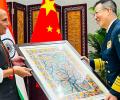
Defence Minister Rajnath Singh, in his meeting with Chinese counterpart Dong Jun in Qingdao on June 26, proposed that India and China should solve the "complex issues" under a structured roadmap comprising steps to de-escalate tensions along the frontiers and rejuvenate the existing mechanism to demarcate the borders.


Blackout was imposed in Jaisalmer, Barmer and other border areas in Rajasthan on Sunday night as a precautionary measure in the wake of Saturday's violation by Pakistan of an understanding reached with India following four days of military confrontation.

'Fears in Washington began to intensify when it was realised that subsequent Pakistani and Indian attacks on major military facilities -- which were significant in terms of geographic scope and intensity -- could rapidly take both sides to where neither actually wanted to go.' 'The US objective was to stop the fighting as soon as possible. Everything else was secondary.'
'Every decision India makes along the LoC, it must also consider implications along the LAC.'

In the letter issued, considering the last night attacks by Pakistani forces in Jammu and Jaisalmer regions, the provision also authorises the use of local authority funds for such emergency measures, giving them precedence over other financial obligations.

The venue, which is due to host Thursday's match between Punjab Kings and Delhi Capitals, has one more match left on schedule -- the May 11 game between Punjab and Mumbai Indians.
